The seafront and Castel dell'Ovo
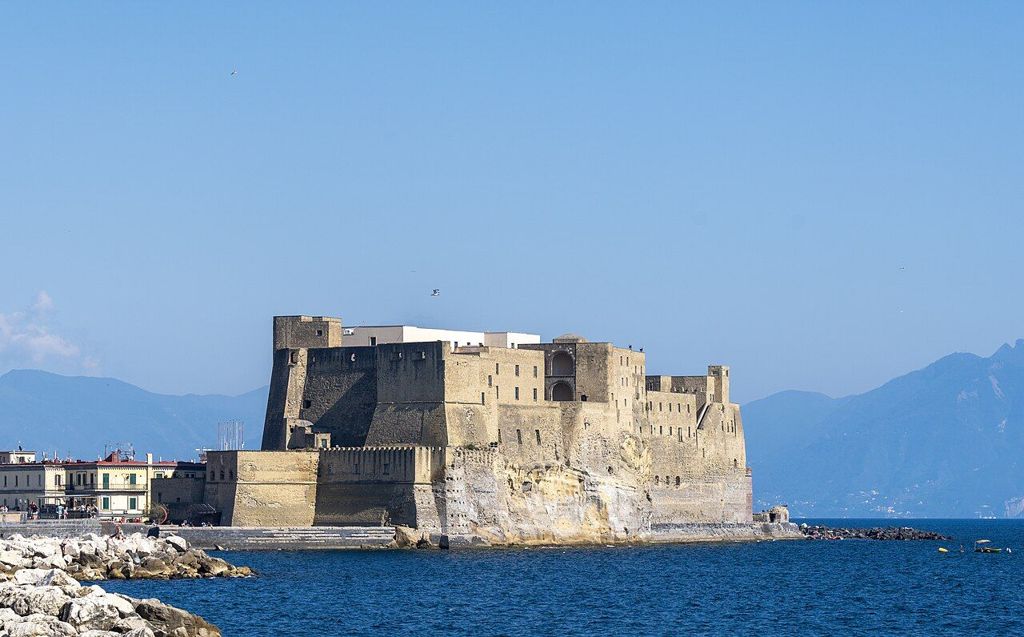
The Naples waterfront is the city's long front room: a car-free promenade, a castle on a rock, a harbour of small boats and Vesuvius waiting across the bay.
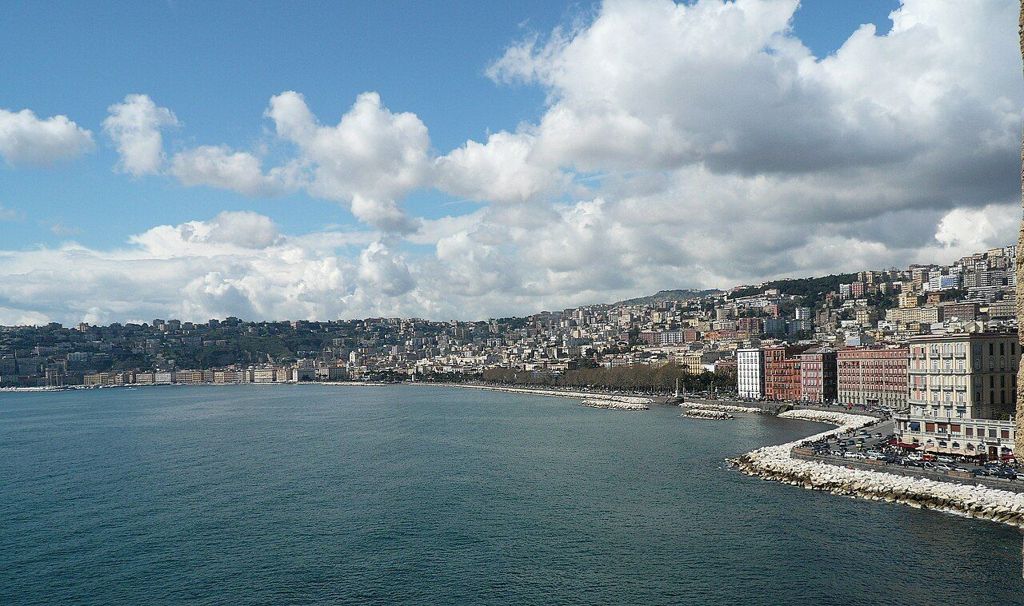
After the narrow lanes of the old centre, the seafront feels like opening a window. The lungomare runs for several kilometres along the curve of the bay, from the castle at its eastern end to the harbour at Mergellina in the west. Much of it is closed to traffic, and on fine evenings it seems that half the city comes out to walk, cycle, jog and sit on the sea wall. Castel dell'Ovo, on its rocky islet, is the natural place to start or finish.
Via Partenope and Via Caracciolo
The seafront takes different names along its length. Via Partenope is the eastern stretch, facing the castle, with large buildings on one side and the water on the other. At its eastern end stands the Fontana del Gigante, a seventeenth-century fountain with stone arches. To the west, Via Caracciolo runs on past the long gardens of the Villa Comunale towards Mergellina.
Via Caracciolo is wide, flat and mostly pedestrian, which makes it one of the easiest walks in a city of hills and steps. The sea wall is made of large blocks of rock where people sunbathe and some swim in summer. Water quality varies. Benches are scattered along the route, and there is little shade at midday.
Between Via Caracciolo and the parallel Riviera di Chiaia runs the Villa Comunale, a long public garden first laid out in the eighteenth century for the Bourbon court. Its paths, statues, fountains and old trees give welcome shade on hot days, and its benches are full of people reading, talking and watching the traffic of bicycles and prams.
Castel dell'Ovo on its islet
Castel dell'Ovo stands on the small island of Megaride, linked to the shore by a short causeway. This is where the story of Naples begins: Greek settlers founded a town called Parthenope on and around the islet before the larger Neapolis was laid out inland. Later, a Roman villa stood here, then a monastic community, and from the Norman period onward a castle that was rebuilt many times.
The name means "egg castle". A medieval legend says that the poet Virgil, regarded in the Middle Ages as a magician, hid an egg inside the foundations, and that if it ever broke, disaster would fall on the city. The legend still gives the castle its name, and the solid walls make it easy to see why people hoped it would last.
Entry to the castle has generally been free, though parts may be closed for events or restoration. Ramps and stairs lead up to the terraces, which give wide views along the seafront, across the bay to Vesuvius and back over the city to the hill of Vomero.
Next door: Vomero, the funiculars and Castel Sant'Elmo
Borgo Marinari
At the foot of the castle, the old fishing quarter of Borgo Marinari curls around a small harbour full of moored boats. It has been turned over largely to eating places with tables along the quay, and it gets very lively on summer nights. By day it is quieter, and the view of the castle walls rising straight from the water is one of the most photographed in Naples.
The small boats rocking in the harbour and the bulk of the castle above them make a good counterpoint to the grand buildings across the road. Walk out along the causeway early in the morning for the calmest light.
By day it is quieter, and the view of the castle walls rising straight from the water is one of the most photographed in Naples.
Vesuvius across the bay
From almost every point on the seafront, Vesuvius dominates the eastern horizon: a broad, two-humped mountain whose main cone is the active volcano and whose older ridge, Monte Somma, curves around it. On clear days you can also see the Sorrento peninsula stretching south and, further out, the outline of Capri.
The eruption of 79 AD that buried the towns at the foot of the mountain is the most famous in its history, but it has erupted many times since, most recently in 1944. To see what it did up close, take the train to Herculaneum, half an hour away along the coast. Afternoon haze often blurs the view; mornings and the hour before sunset tend to be clearest.
Evening walks and the passeggiata
The seafront comes into its own in the evening, when the heat eases and the light over the bay turns gold and then pink. Families walk slowly, couples sit on the rocks, and street sellers appear with balloons and toys. The walk from Castel dell'Ovo to Mergellina and back takes around an hour and a half at an easy pace, longer if you stop.
- Petty theft is uncommon here but not unknown, especially in crowds. Keep your bag closed and your phone in hand rather than on the wall beside you.
- Summer days are hot and exposed. Walk early or late.
- Strong winds can whip spray over the sea wall in winter. Keep back from the edge in rough weather.
Getting there and nearby
From the Municipio metro station it is a short walk past the Royal Palace and Piazza del Plebiscito to the start of Via Partenope. The square is vast and semicircular, framed by the curved colonnade of the church of San Francesco di Paola and facing the long front of the palace, and it is worth a pause on the way down to the water. Mergellina, at the western end, has a station on Line 2 and the port for some ferries and hydrofoils. From the seafront the funiculars up to Vomero are a short walk inland, and the old centre lies about twenty minutes uphill on foot; our guide to Spaccanapoli picks up the walk from there.
Before you set off
| Getting there | Metro Line 1 to Municipio, then walk |
|---|---|
| Metro and trains | Line 1 to Municipio, then walk |
| Bring | Sunscreen, a light jacket for evening, water |