Spaccanapoli, the street that splits the city
One long, straight, narrow street runs through the heart of old Naples. Follow it from Gesù Nuovo eastward and you walk the line Greek planners drew some 2,500 years ago.
Seen from the heights of Vomero, the old centre of Naples is cut cleanly in two by a single straight line. That line is Spaccanapoli, a popular name meaning roughly "the one that splits Naples". On the ground it is not one street but a chain of them under different names, the best known being Via Benedetto Croce and Via San Biagio dei Librai. It is narrow, loud, full of scooters and churches, and it follows almost exactly the course laid out when the Greek city of Neapolis was planned in the fifth century BC.
A street plan older than Rome's empire
The Greek founders of Neapolis laid out their new city on a grid. Three long east-west streets, the decumani, were crossed at regular intervals by narrower north-south lanes. Spaccanapoli is the lower decumanus. The main one, now Via dei Tribunali, runs parallel just to the north, and the upper one follows Via dell'Anticaglia beyond it. The Romans kept the plan, and later centuries built on top of it rather than sweeping it away.
The result is that the centro storico, listed by UNESCO as a World Heritage Site, still reads like a diagram. Stand at any crossing and look along the side lanes: they run straight uphill and downhill, lined with tall palazzi, washing lines and shrines set into the walls. Below the paving lie the older layers, which you can visit on a guided walk through the quarries and cisterns under the centre.
Distances are short. You can walk the full length of Spaccanapoli in half an hour without stopping, but almost nobody does. Allow a morning at least, and come back at dusk when the shutters roll down and the street fills with people heading home.
Gesù Nuovo and its diamond-point facade
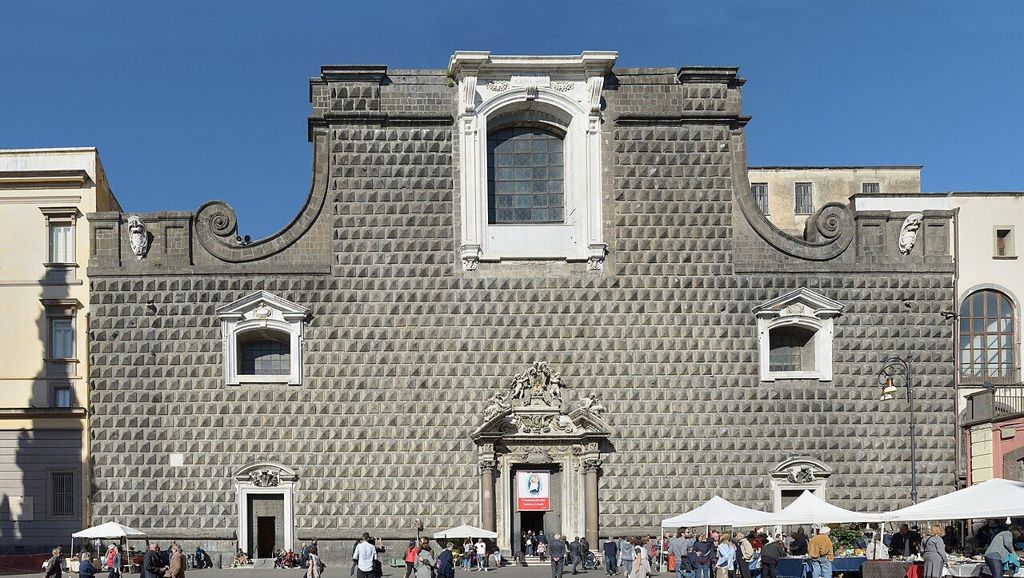
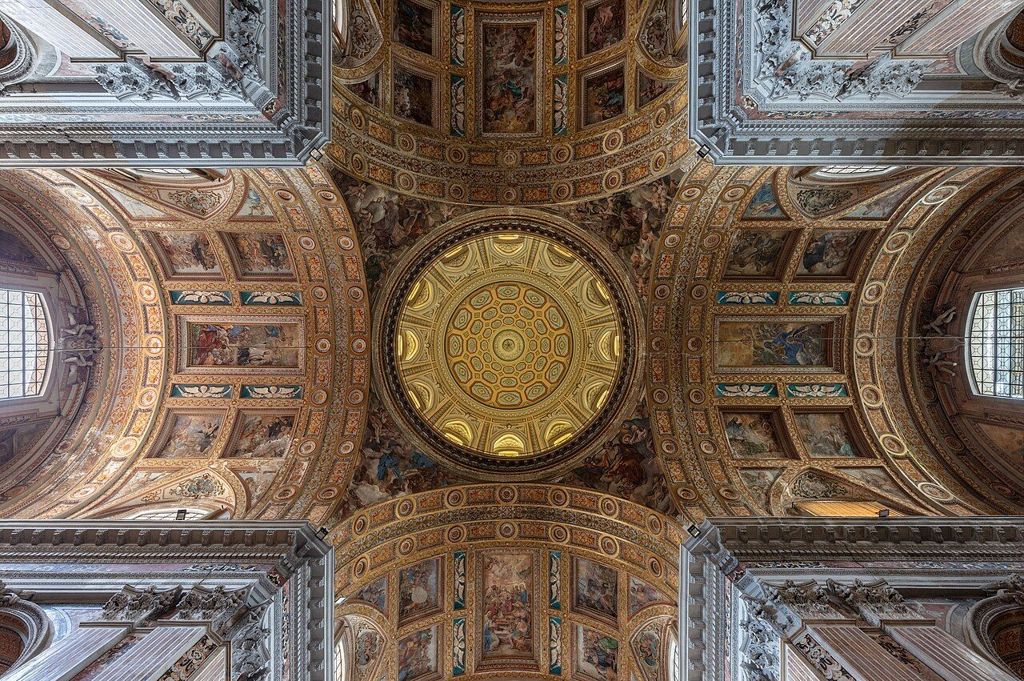
Start at the western end, in Piazza del Gesù Nuovo. The church that gives the square its name has one of the strangest fronts in Italy: a flat wall of grey stone cut into pyramid-shaped points. It was built in the fifteenth century as the facade of a noble palace, and when the Jesuits turned the building into a church in the late sixteenth century they kept it. Inside, the mood changes completely, with coloured marble, gilding and painted ceilings in full Baroque style.
In the middle of the square rises the Guglia dell'Immacolata, a tall, heavily carved spire topped by a statue of the Virgin. Spires like this, raised by religious orders and the faithful, appear in several squares of the old centre. Gesù Nuovo is an active church, so dress modestly and keep quiet during services.
Santa Chiara and the majolica cloister
Across the street stands Santa Chiara, a large Gothic church founded in the fourteenth century by the Angevin royal family. It was hit by bombing in 1943 and burned for days. The interior you see today is the result of a post-war restoration that returned it to a plainer, more Gothic look, with tall windows and bare walls instead of the Baroque decoration that had been added over the centuries.
The real reason to linger is behind the church. The cloister of the convent of the Poor Clares was redesigned in the eighteenth century, and its walkways are lined with octagonal pillars and long benches faced with hand-painted majolica tiles. The tiles show vines, lemons, country scenes, boats and figures in yellow, green and blue, and they are framed by a formal garden of citrus trees. It is one of the quietest places in the city centre.
Next door: The archaeological museum: Pompeii indoors
The cloister and the small museum next to it charge an admission fee, separate from the church itself, and opening times vary by season and day of the week. Allow at least forty minutes.
Along the decumanus
East of Santa Chiara, the street opens briefly into Piazza San Domenico Maggiore, with another spire and the high apse of the church of San Domenico. A short way up a side lane is the Cappella Sansevero, a small chapel famous for the Veiled Christ, an eighteenth-century marble figure carved so that the shroud appears transparent. Tickets for the chapel are timed and often sell out at busy periods, so plan ahead.
Further along, at a small widening of the street, a weathered Roman statue of a reclining river god represents the Nile. It recalls the Alexandrian merchants who lived in this quarter in antiquity. Around it, the street is lined with bookshops, small churches and stalls, and the noise rarely drops.
Stand at any crossing and look along the side lanes: they run straight uphill and downhill, lined with tall palazzi, washing lines and shrines set into the walls.
San Gregorio Armeno and the nativity makers
Turn left up Via San Gregorio Armeno, the lane that links Spaccanapoli with Via dei Tribunali. This short, steep street is given over almost entirely to the craft of the presepe, the Neapolitan nativity scene. Workshops spill out onto the pavement with shepherds, angels, market stalls, tiny loaves of bread, miniature fish and whole terracotta villages. Alongside the traditional figures you will see satirical statuettes of footballers, politicians and celebrities, updated each year.
The lane is busy all year and very crowded in the weeks before Christmas, when it can be hard to move. Go early in the day if you want to look closely. The church of San Gregorio Armeno, partway up, has a richly decorated interior and a cloister belonging to its convent. To see the craft at its most ambitious, the historic cribs in the museum at San Martino are covered in our guide to Vomero and Castel Sant'Elmo.
Practical notes for the old centre
- Most churches close for a few hours around midday and reopen in the late afternoon. Times are revised through the year, so confirm them on the day.
- Cover shoulders and knees for church visits.
- Petty theft happens in crowded streets, as in any big city. Keep phones and wallets in front pockets or a zipped bag, and you are unlikely to have trouble.
- Scooters use even the narrowest lanes. Keep to the side and listen behind you.
- The cobbles are uneven and slippery after rain. Flat shoes with grip help.
From the eastern end of Spaccanapoli it is a short walk north to the cathedral on Via Duomo, or west and uphill to Piazza Dante and the metro. Many visitors pair the walk with a few hours at the archaeological museum, a little to the north, or carry on down to the water for an evening on the seafront.
Before you set off
| Getting there | Metro Line 1 to Dante, then walk |
|---|---|
| Metro and trains | Line 1 to Dante, then walk east |
| Bring | Comfortable shoes, small change, a bag worn in front |