The city under the city
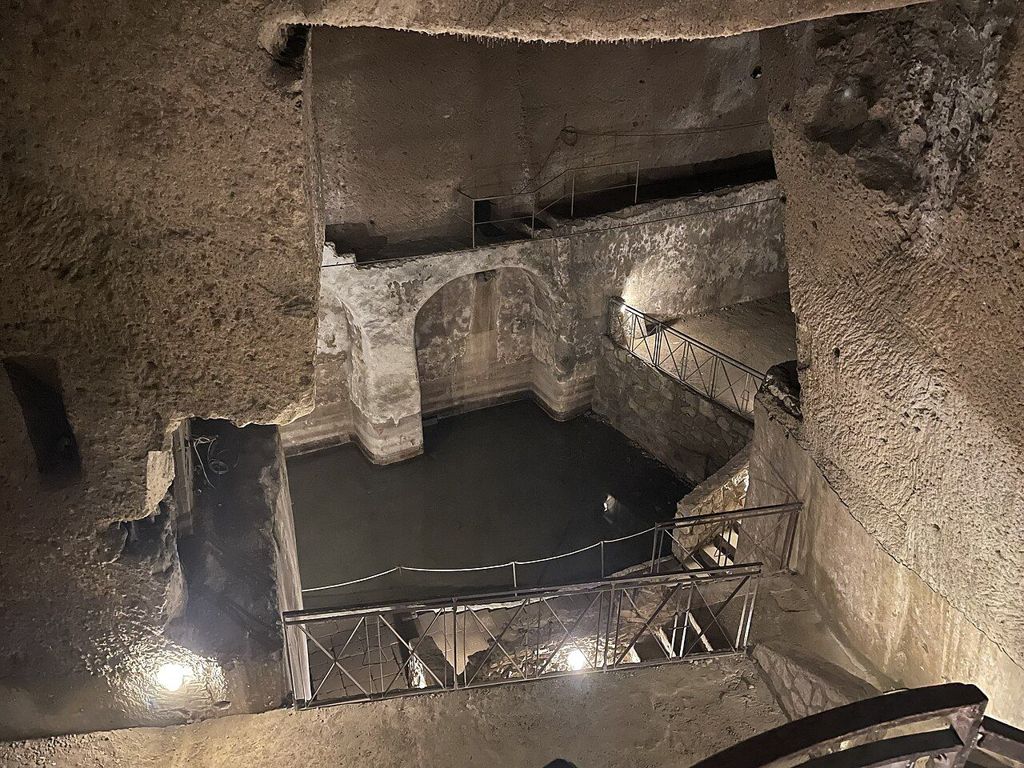
Naples is built from the soft yellow stone beneath it. Centuries of quarrying left a second city of tunnels, cisterns and shelters, and some of it is open on guided visits.
Much of Naples stands on tuff, a volcanic stone that is soft enough to cut by hand and strong enough to build with once it dries. From the time the Greeks founded the city, builders simply dug it out from under their own feet. The holes they left became cisterns, then rubbish pits, cellars, shelters and, for some visitors, the most memorable part of a trip to Naples. Two different underground worlds are open: the quarries and cisterns beneath the old centre, and the early Christian catacombs on the hill to the north.
How a city digs itself out
The yellow tuff under Naples was laid down by ancient eruptions in the Campi Flegrei, the volcanic area west of the city. Greek settlers cut blocks from it to build the walls and temples of Neapolis, working downward and leaving large chambers behind. In Roman times the chambers were joined to an aqueduct system that brought spring water from the hills inland, and they became a network of cisterns linked by narrow channels.
For centuries, households drew water through shafts that ran from the cisterns up to courtyards and palazzi. Specialist well-workers moved through the channels to keep them clean. After a cholera outbreak in the late nineteenth century, the old water system was closed in favour of a modern supply, and many of the cisterns were abandoned or filled with debris.
Shelters from the bombs
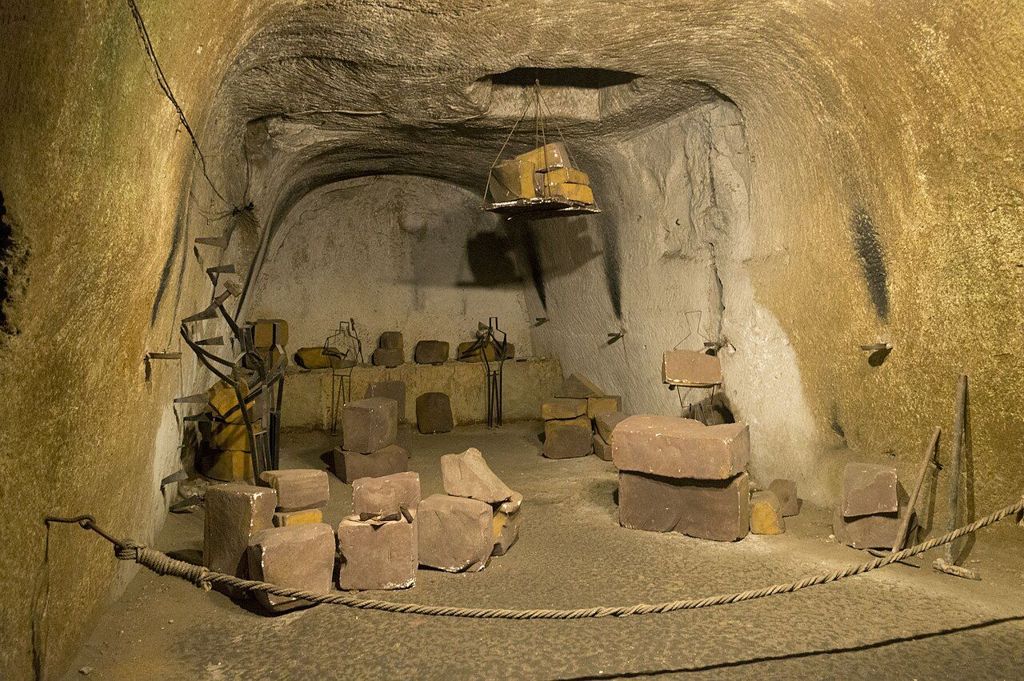
During the Second World War, Naples was bombed heavily, and the empty cisterns were turned into air-raid shelters. Stairways were cut, electric light and benches were added, and large numbers of people spent long nights underground. On some visits you see what they left behind: graffiti, children's toys, old signs, and the remains of the improvised fittings that made the shelters habitable.
After the war much of the network was filled with rubble from bombed buildings. Clearing parts of it and opening them to visitors has been the work of decades, and it continues.
Guided visits beneath the centre
Several organisations run guided visits into different parts of the underground, with entrances in and around the old centre, including near Piazza San Gaetano on Via dei Tribunali, the main street of the Greek grid that also gives a name to Spaccanapoli and its neighbours. Visits are only possible with a guide, usually take around an hour to an hour and a half, and run in Italian and English at set times.
Next door: The seafront and Castel dell'Ovo
A typical route takes you down a long staircase some tens of metres below the street, through large cisterns with walls still marked by the tools that cut them, and past wartime traces. A highlight of some visits is a stretch of very narrow passage, often lit only by candle, where you turn sideways to squeeze through. If you are claustrophobic or broad-shouldered, ask about it in advance; there is usually a way round.
Some visits also lead into ordinary-looking houses whose cellars contain the curved walls of the Roman theatre of Neapolis, which the city later built over. It is a striking reminder that the old centre is built in layers.
- Temperature underground stays cool and fairly constant all year. A light layer helps in summer, when the change from the street is sharp.
- Steps are steep and can be damp. Wear closed shoes with grip.
- Visits are not suitable for wheelchairs and can be hard for people with limited mobility.
The catacombs of San Gennaro
North of the old centre, on the slope of Capodimonte above the Sanità district, lie the catacombs of San Gennaro, the largest early Christian burial site in southern Italy. Unlike the Roman catacombs, which are low and cramped, these are cut on a generous scale into the tuff, with broad passages and high chambers on two main levels.
The catacombs grew around the tomb of a noble family and became a place of pilgrimage after the remains of San Gennaro, the city's patron saint, were placed here. Over the following centuries bishops and ordinary Christians were buried in the walls and floors. The walls still carry painted and mosaic decoration from the early centuries of Christianity, including portraits of the dead and early images of the saint, along with a small underground basilica.
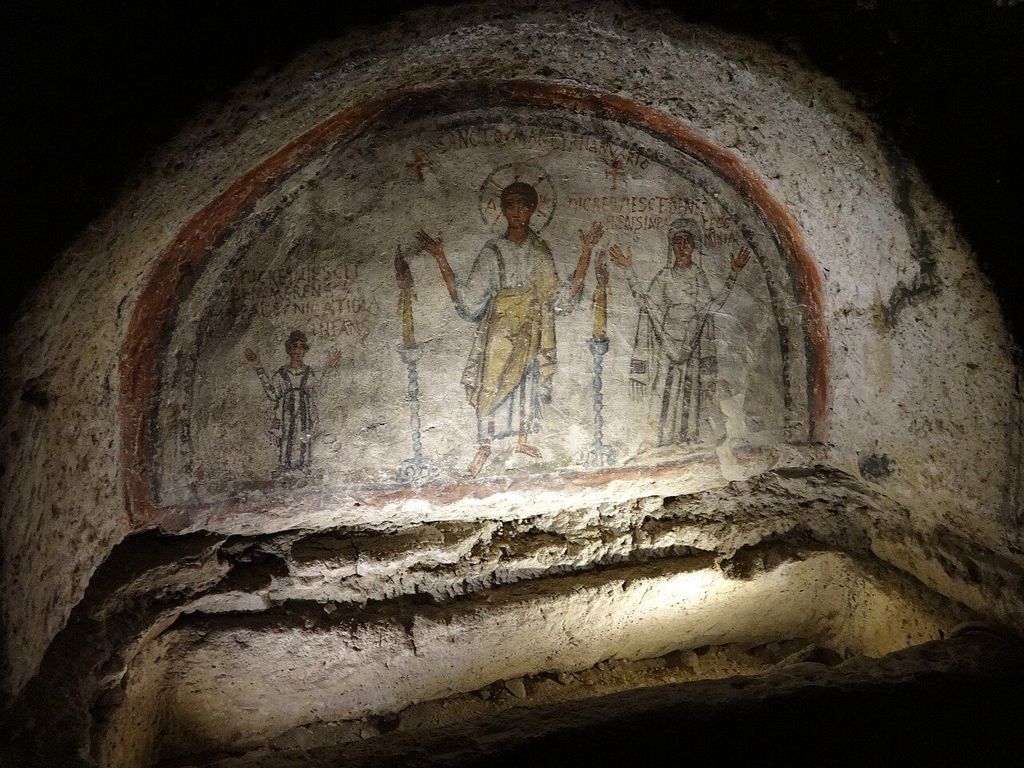
Visits are guided and leave at regular times from the entrance beside the large domed church of the Madre del Buon Consiglio. The ticket has often also covered the catacombs of San Gaudioso in the Sanità below. The archaeological museum is a short walk downhill, and many visitors combine the two; our guide to the archaeological museum covers what to see there.
Planning your descent
A single underground visit and the catacombs make a full but manageable day, especially in hot or rainy weather when being below ground is a relief. Book ahead in peak season and at weekends, when groups fill quickly. Bring the minimum: bags are a nuisance in narrow passages, and some sites ask you to leave large ones at the entrance. Photography is usually allowed without flash, but follow the guide's lead.
Above all, take the visits slowly. The quarry walls, the water channels and the wartime scrawl tell the history of Naples in a single descent, from Greek stone-cutters to families waiting out the bombs. Back at street level, the city looks different once you know what lies under it. For the open-air counterpart, the buried Roman town at Herculaneum is a short train ride away.
Before you set off
| Getting there | Metro Line 1 to Dante or Museo |
|---|---|
| Metro and trains | Line 1 to Dante or Museo |
| Bring | A light layer, closed shoes, a small torch |